 +91 - 8010-555-111
 INR
INR  AUD - Australian Dollar
  BHD - Bahraini Dinar
  GBP - British Pound
  CAD - Canadian Dollar
  EUR - Euro
  HKD - Hong Kong Dollar
  IDR - Indonesian Rupiah
  ILS - Israeli New Shekel
  JPY - Japanese Yen
  KWD - Kuwaiti Dinar
  MYR - Malaysian Ringgit
  MUR - Mauritian Rupee
  NZD - New Zealand Dollar
  OMR - Omani Rial
  PHP - Philippine Peso
  QAR - Qatari Riyal
  SAR - Saudi Riyal
  SGD - Singapore Dollar
  CHF - Swiss Franc
  USD - US Dollar
  AED - United Arab Emirates Dirham
  VND - Vietnamese Dong






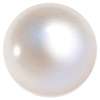
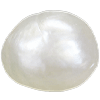
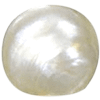
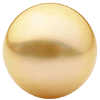
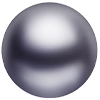
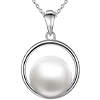
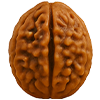
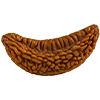





Worldwide the standard unit used for weighing diamonds and gemstones is the metric Carat. It takes its name from the carob seeds, these seeds have a fairly uniform size and were used by early gem traders as counterweights in their balance scales.
How Gemstone Weight is Measured
Gemstones are weighed using highly accurate digital weighing scales specially designed for precious stones and diamonds. Since even a slight variation in gemstone weight can significantly affect the value and pricing of a gemstone, precision is extremely important in gemstone weighing.
Generally, the larger the gemstone, the rarer and more valuable it becomes. This is why the price per carat of gemstones increases with size. For example, a natural 5 carat Ruby of good quality may cost significantly more per carat than a similar 1 carat Ruby because larger natural gemstones are much rarer to find.
What is Carat in Gemstones?
The modern metric carat was adopted by the internationally in 1913 and today a carat weighs exactly the same in every corner of the world.
Do not confuse Carat with Karat which refers to the purity of gold.
One carat is equal to 200 milligrams or 1/5th of a gram. It can be further subdivided into 100 points or Cents. For example, a 50-points diamond weighs 0.50 carats.
What is Ratti in Gemstones?
In India, gemstones are also commonly weighed in Ratti, a traditional unit of gemstone weight used since ancient times in Vedic astrology. Different regions historically followed slightly different Ratti measurements, but today one Ratti is generally considered close to 0.90 carat.
1 Carat = Approximately 1.11 Ratti
1 Ratti = Approximately 0.90 Carat
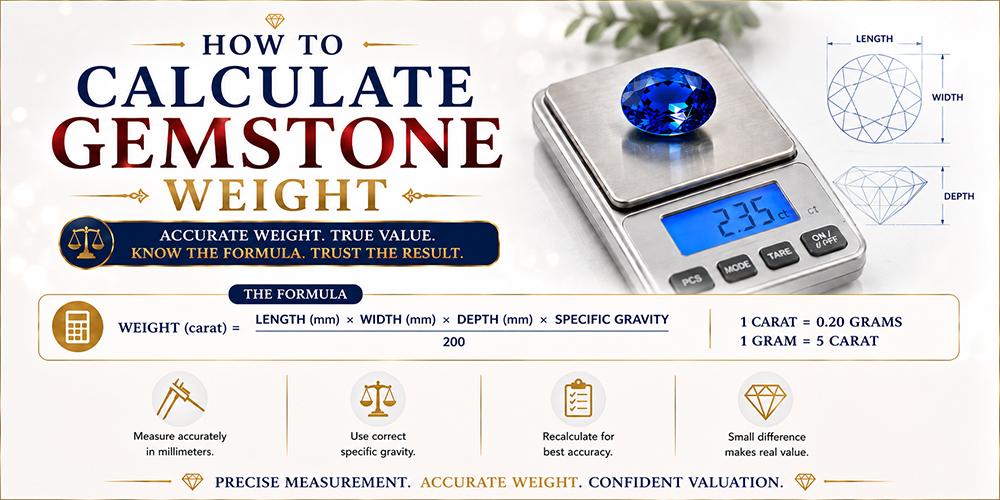
Formula to Calculate Gemstone Weight
Gemstone weight can also be estimated mathematically by using the dimensions of the stone along with its specific gravity. Gemstone cutters and jewelers often use this method when the stone is mounted in jewelry and cannot be directly weighed on a scale.
Weight (Carat) = Length × Width × Depth × Specific Gravity ÷ 200
In this formula, the length, width, and depth of the gemstone are measured in millimeters. The specific gravity differs from one gemstone to another depending on its mineral composition and density.
What is Specific Gravity in Gemstones?
Specific gravity refers to the density of a gemstone compared to water. Every gemstone has a different density. For example, Diamond, Ruby, Emerald, and Blue Sapphire all have different specific gravity values. This is why two gemstones of identical size may still have different carat weights.
Gemstones with higher density usually weigh more even if their dimensions appear similar to lighter stones.
Why Accurate Gemstone Weight Matters
Even a small difference in gemstone weight can create a major difference in pricing and valuation. Precious gemstones are priced on a per-carat basis, and larger stones are significantly rarer in nature. Therefore, accurate gemstone weight measurement is extremely important while buying or selling gemstones.
Professional gemstone laboratories and jewelers use highly calibrated digital weighing machines and measuring tools to ensure precision and authenticity in gemstone valuation.
Difference Between Size and Weight
Many people assume that larger-looking gemstones always weigh more, but that is not necessarily true. The actual weight of a gemstone depends on both its dimensions and density. A gemstone with greater depth may weigh more than a wider stone with a shallow cut.
This is why gemstone dimensions alone cannot determine exact carat weight without considering the specific gravity and proportions of the stone.
Importance of Gemstone Weight in Astrology
In Vedic astrology, gemstone weight plays an important role because the intensity of the gemstone is believed to increase with size and weight. However, quality is always considered more important than quantity. A smaller natural gemstone with fine color, clarity, and transparency is usually preferred over a larger low-quality or treated stone.
It is also important that the gemstone should be large enough to make proper skin contact when worn in a ring or pendant for astrological purposes.



Thoughts